
Beschreibung
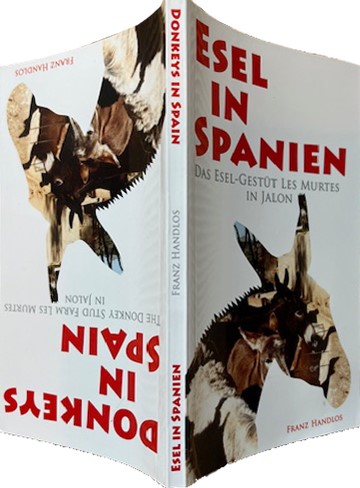
Handlos, Franz (2004). Esel in Spanien: Das Esel-Gestüt Les Murtes in Jalon. Donkeys in Spain: the Donkey Stud Farm Les Murtes in Jalon. Costa Nachrichten Verlag S.L. 53 und 49 Seiten. ISBN 978-8489111219
vielleicht auch noch Don Quijote, aber bei seinem treuen Begleiter Sancho Pansa und dessen Esel hört die Überlegung schon auf. Und warum wohl? Weil es fast keine vierbeinigen Esel (im Gegensatz zu den zweibeinigen) mehr gibt. Jawohl, liebe Leser, diese seit Jahrtausenden treuesten Gefährten des Menschen stehen überall auf der Welt und insbesondere auch in Spanien auf der Roten Liste der aussterbenden Tiere. Und das haben die geduldigen Vierbeiner bei Gott nicht verdient, auch wenn sie durch die Technisierung in der Landwirtschaft nicht mehr benötigt werden. Betrachten wir nur die Costa Blanca und hier wiederum als Beispiel Jal6n im Hinterland, in der Nähe von Benissa, nur wenige Kilometer von der Küste entfernt. Noch im 17. Jahrhundert lebten im dortigen Gemeindegebiet ca. 4000 Einwohner und mehr als 1000 Esel und Maultiere. Der alte Dorfschmied von Jal6n weiss zu berichten, dass es 1975 in seinem Dorf noch 500 Esel und Maultiere, in Lliber 200 und in Alcalali 300 gab. Und heute? An einer Hand kann man die Burros zählen, die vom Menschen noch ihr Gnadenbrot erhalten. Aber halt! Ausgerechnet in den Bergen von Jal6n beginnt das Reconquista-Zeitalter mit dem Esel-Gestüt Les Murtes der Familie Edith und Alex Aretz, die es sich zur Aufgabe gemacht haben, den spanischen Esel vor dem Aussterben zu retten. Bravo kann man dazu nur sagen! Aber dazu später.
Also in the province of Malaga there is quite a lot going on, especially at Mijas on the Costa del Sol. There are Sunday trips on offer by donkey carts, rather than by car. They call it „Burro-Taxi“ and many holidaymakers from Torremolinos and Fuengirola go up to the hills for no other reason but to meet their beloved donkeys at Mijas. What are you saying? You don’t fancy this ecological alternative? No petrol consumption, no car driver’s stress, no air pollution, no parking problems at any place; isn’t this almost a paradise situation? Imagine if we all came along riding on a donkey! No petrol, no exhaust f umes, but every day loads of oats and hay instead; and what is more, the emissions from behind were not such as to extend the hole in the ozone layer but might be used as fuel in a stove, once it was dry! With no other choice the „suitable cross-country-vehicle“ even eats thistles, manages without water for some days and is as meek as a lamb to its two-legged owner. Have a try driving your cross-country jeep without petrol; you can whistle for it … you’ll be left high and dry. So never let it be said that donkeys were stubborn and silly! A sausage dog not obeying its master is called a character. Behaving the same way „Mr. Longears“ is interpreted most negatively -stubborn. On the Costa del Sol, too, four-legged donkeys are getting fewer and fewer; the remaining specimens are multicultural, as it were, since the African donkey also left its genetic make-up behind. Since I have been to Mijas, I look at the world in a different way! Despite the strong smell around the taxi rank I am sure should Don Quixote ever come back, Sancho Pansa wouldn’t have to do without his donkey.